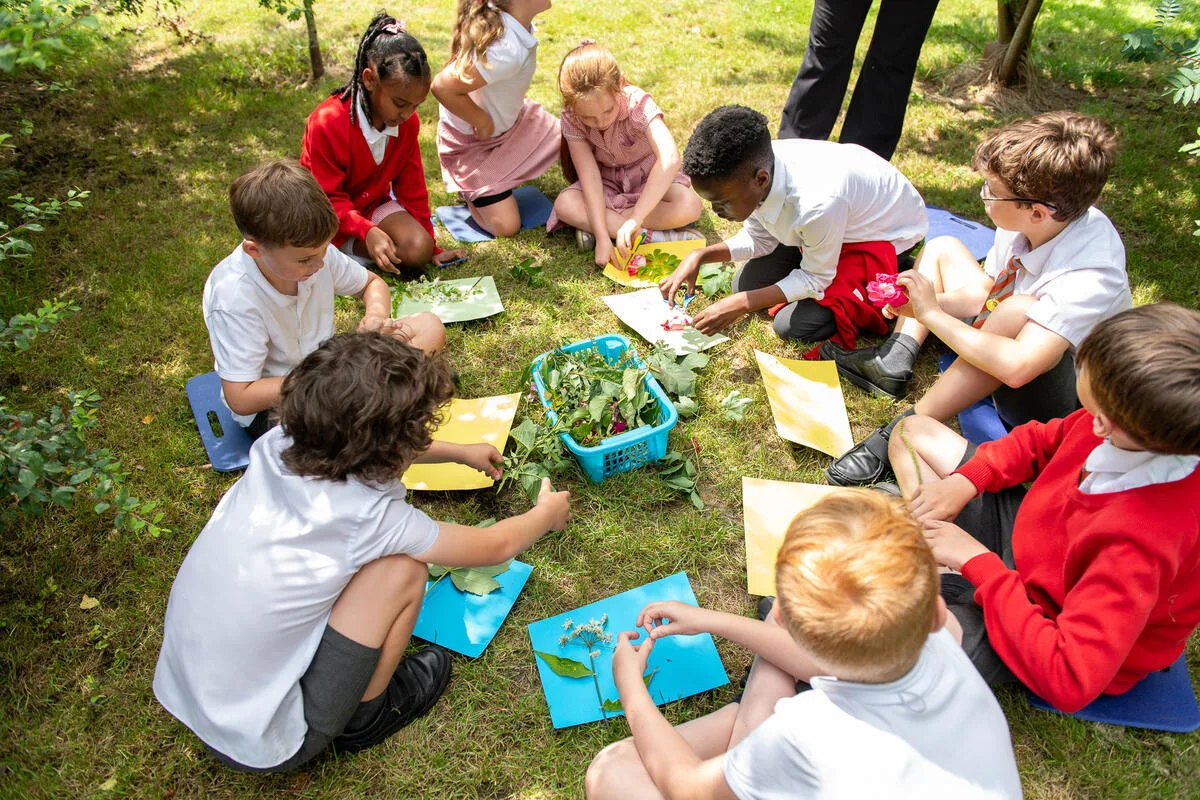
Transforming a school’s grounds with £10,000
Creating a deeply natural play and learning experience for children and teachers in a city-centre school in Swansea
We’re currently open for round two of the Happy By Nature fund, in partnership with WWF-UK. Round one is well underway, and so to give you an idea of what recipient schools are doing as part of the project let’s look in on Hafod Primary School in Swansea.
Hafod was a great choice for this project as they are in the centre of this seaside city which is not very far from all sorts of beautiful natural landscapes, and yet it’s really not easy to access unless you have a car.
The school has an enthusiastic lead teacher and evidence of some good problem-solving in their grounds already, for example the huge sandpit they’ve installed, and some tree and hedge-planting to combat a flooding problem. The grassy section of the site is sloped, which really dictates the kind of playing that the children do there. These are all ordinary, everyday challenges that will be familiar to many schools.

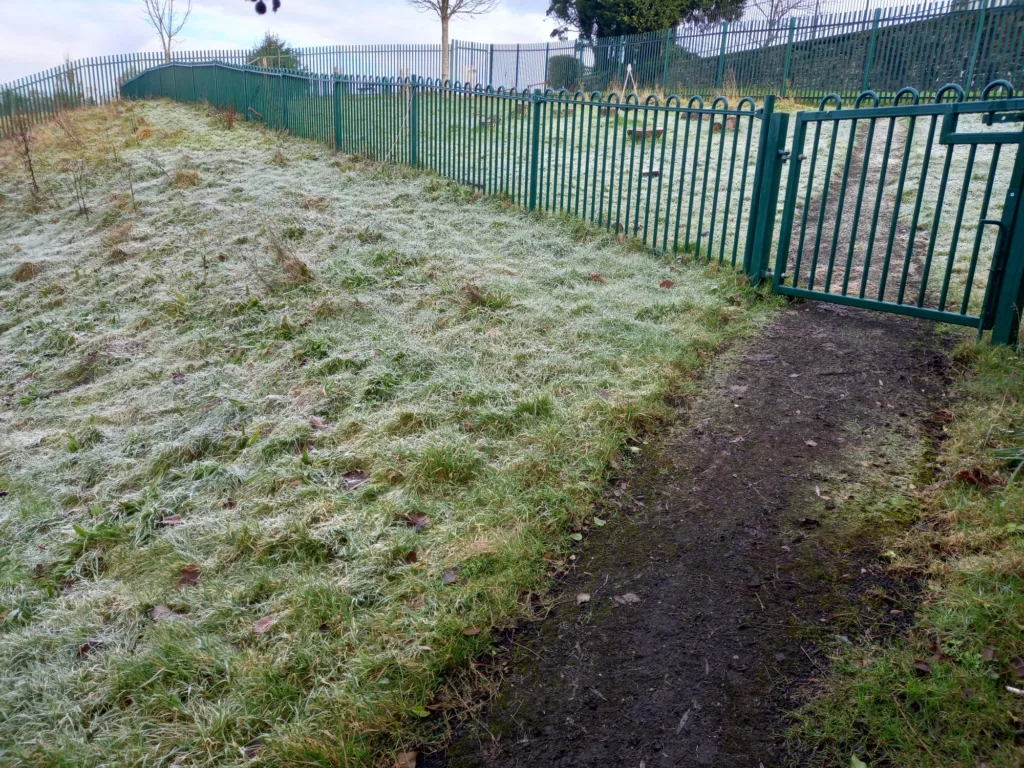

Until recently they only had tarmacked yards – a ‘top’ yard and a ‘bottom’ yard. A grassy sloped area is part of the adjoining Hafod Park that has recently been gifted to them by the council, to develop as an outdoor learning space.
That’s where Happy By Nature comes in. The project involves a Learning through Landscapes staff member going into the school to help the pupils and teachers think through what they would like the space to be like, how they’d imagine using it. Then a landscape architect joins them. In this case it was Felicity Robinson who works specifically with schools to improve their grounds for learning and play. Felicity has great experience in making the most of the £10,000 budget.
Through exploring the space together, the teachers, the children, LtL’s Iestyn Thomas, and Felicity settled on a priority of self-directed play. The priority was to design spaces that encouraged the children to have their own ideas, and populate them with things that would be inspiring, and could be used imaginatively for all sorts of purposes. It was also important that it would be just as welcoming for other creatures too, and that sharing the space would be an important part of the children’s outdoor experience.
Contractors will come in over the next few months, and we will report again when the changes have taken place. For now, here are Felicity’s designs.
Creating a damp garden
The project begins with an area in a corner of the school yard that will be accessible during all playtimes. It’s currently tarmacked, and struggles with water run-off when it rains. There’s some broken fencing so the corner is cordoned off at the moment.
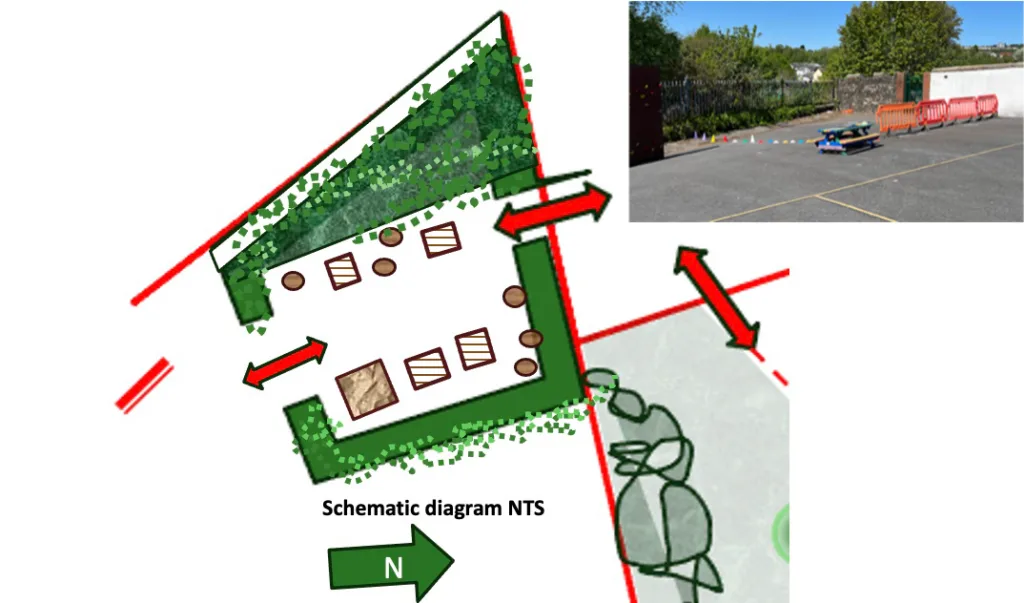
This will become the Play Explorer Zone – the Parth Fforiwr Chwarae in Welsh – a playful, natural space that re-imagines a damp corner as a colourful, textured damp garden. The planter structures will be raised on engineering brick to allow water to drain in from the sloping playground. The planters around the edge will be backed by trellises, with climbing plants – honeysuckle, hops, ivy, clematis and roses – creating a calm, fragrant, insect-friendly and ever-changing backdrop, and discouraging climbing the trellises!
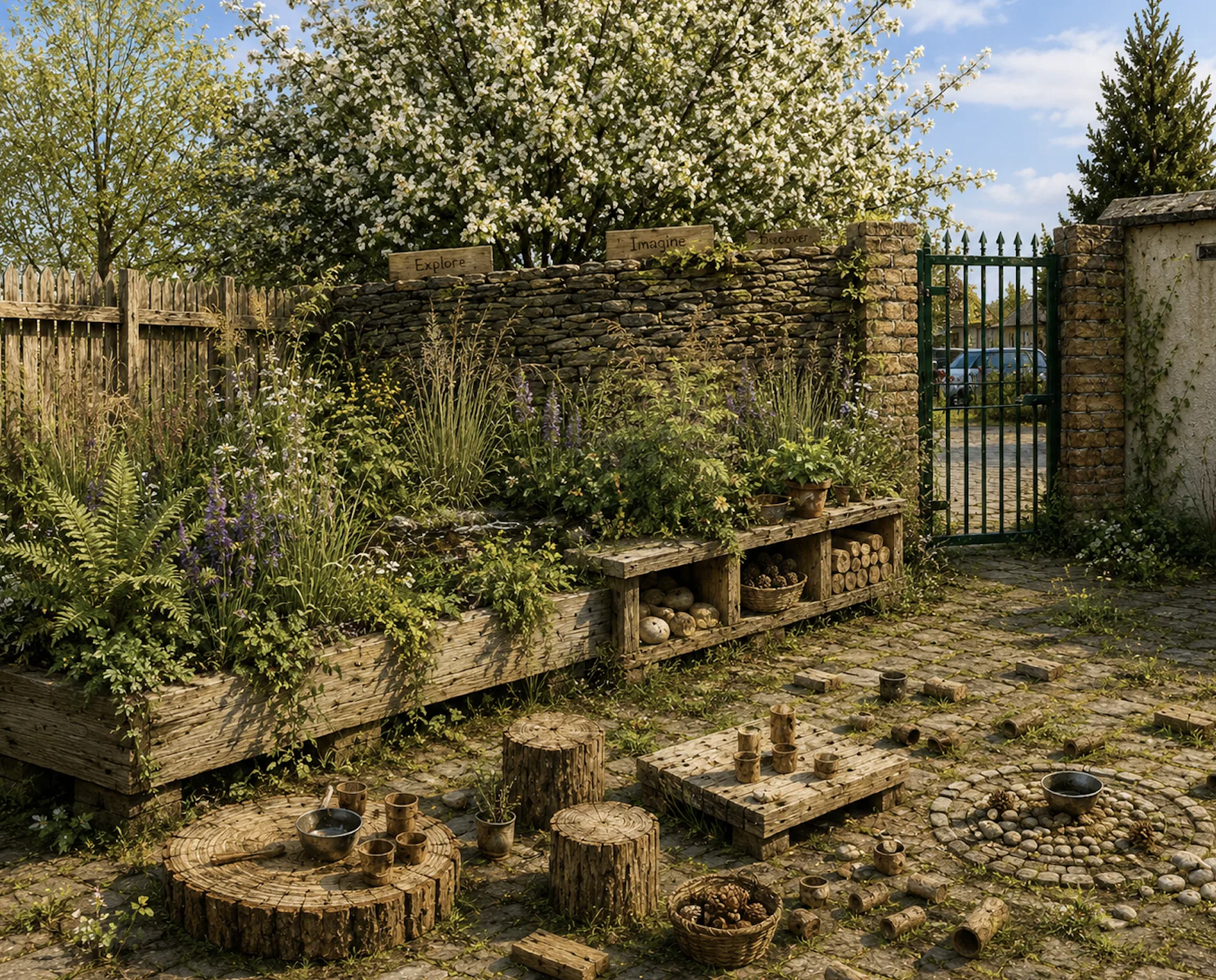
AI generated image by landscape designer
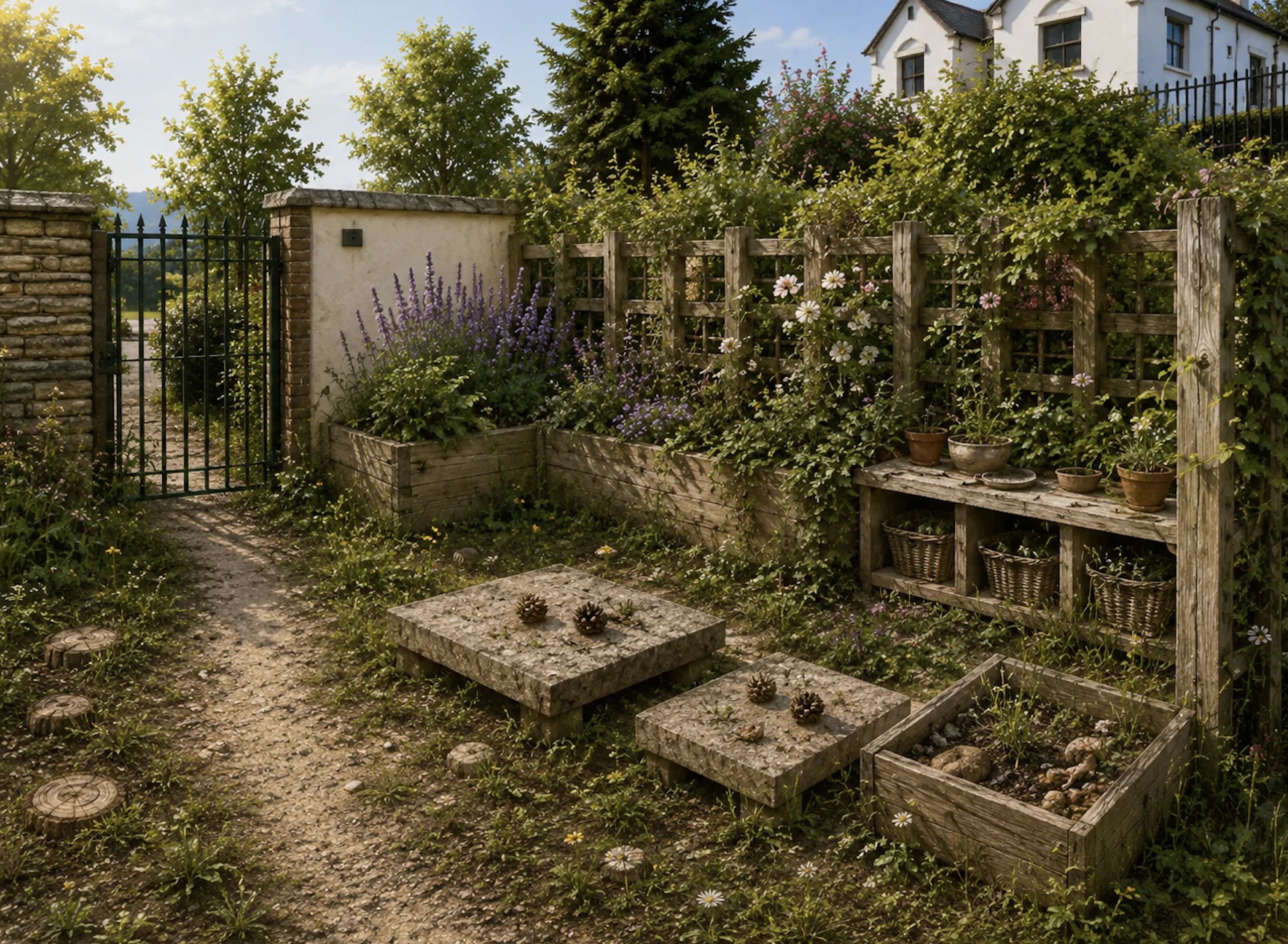
AI generated image by landscape designer
Loose parts play
The Play Explorer Zone will be stocked with all sorts of things – robust, natural or reclaimed materials that can become whatever the children need them to be: bridges, pathways, sculptures, habitats, dens, sorting collections, transient art, balancing challenges, storytelling props and construction materials. There will be little items like pinecones, feathers, shells and driftwood, stone of all sorts, from beach stones to slate pieces; wood of all sorts from hazel and willow rods to timber offcuts, bark pieces and wooden cable reels. And there will be construction materials – short lengths of robust drainage pipe, scaffold board offcuts, wooden wedges, short sections of guttering, bamboo canes etc, which can be contributed by families and local builders. There will be storage racks and cubbies to keep all of this natural treasure in order, off the ground, and easily findable for next time.
A space like this, open to the pupils to come and go as they wish during playtime, will give them a place to play in a different way. They can get away from the noise and footballs in the yards, they can keep an eye on the natural cycles of the plants and creatures in relation to the season and weather. They can choose to focus on small assembling and sorting and creating tasks – making potions for example – or bigger and more physical building tasks that will use their bodies in varied ways. They’ll be able to spend playtimes in imaginative worlds, engaged with teamwork, or returning to projects over several days. They’ll start to look out for good things to bring in from home or weekend trips, and develop a sense of what natural treasure looks like, and of ownership and agency over the space.
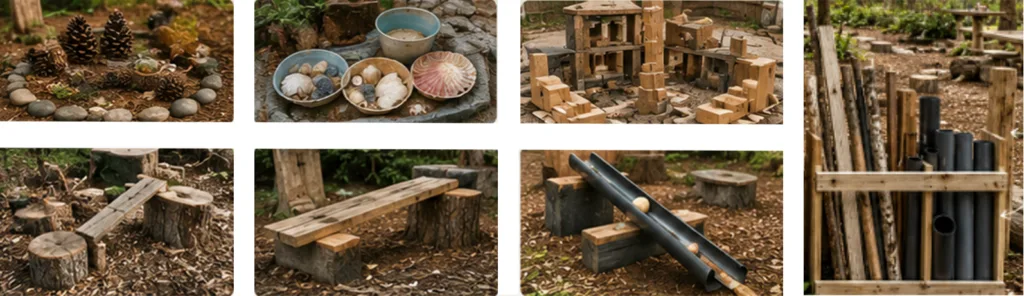
AI generated images by landscape designer
The grassy slope
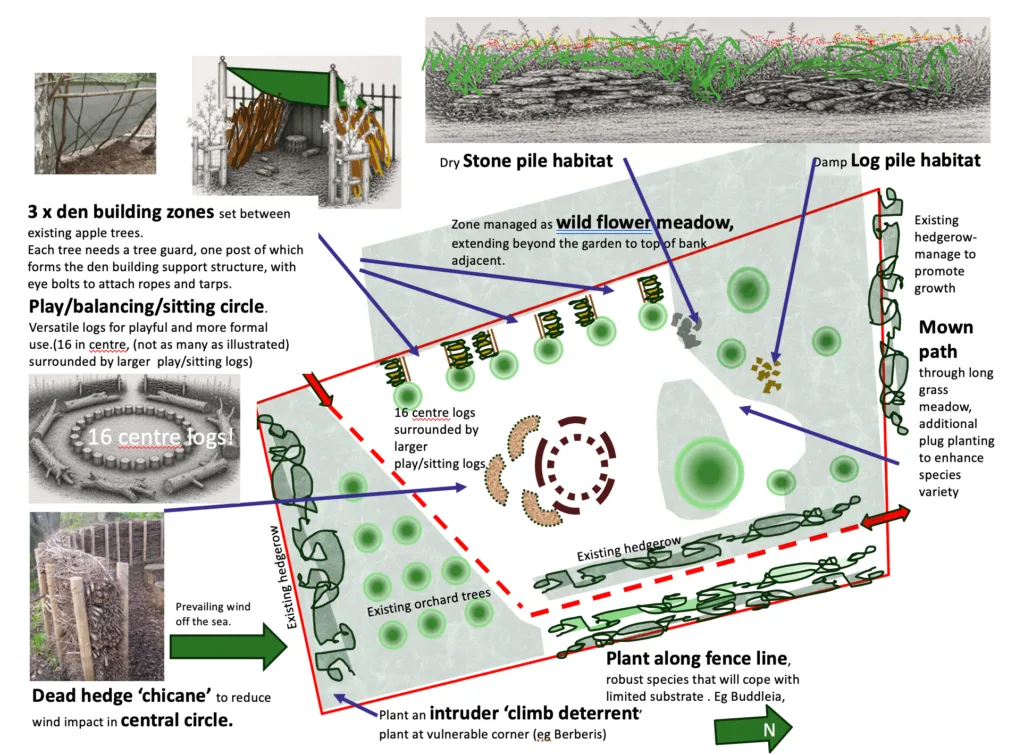
This area of the site – a section of Hafod Park that’s been gifted by the council – will be opened up to the children during outdoor sessions. It’s called the Growing Wild Zone, or Y Gardd Tyfu in Welsh, and is as much about cultivating a love of wildness in the children as it is about growing more plants. A bit of landscaping and a lot of creative thought will transform a grassy slope into a variety of habitats and play spaces, with lots of opportunity for more formal learning and observation.
The den-building area
One of the loveliest things planned for this zone is the den-building area. A row of existing apple tree saplings will have protective wooden frames built around them, and these will have eye bolts for fastening tarpaulins to. There will be loose branches and other bits and pieces to aid den construction of different sizes and designs, from several cubbies to one long corridor and everything in between. This will spark all sorts of imaginative scenarios and role play games.
The log circle
This has inner and outer circles so that it works for small groups or whole classes. Logs can be used for balancing on and playing with, and as a more formal gathering place for outdoor lessons.
Planting around the site
Existing hedges will be added to and managed to serve purposes, including sheltering the site from the sea winds from the south, and discouraging intruders. One edge will have a wildflower meadow in the park beyond, that they’ll add flower species to for colour and variety for pollinators. The grass in the site will be plug-planted with extra species and left to grow naturally, with a mown path through the site. The children can do a lot of the planting. For the fenceline Felicity has proposed plants that look and feel good, smell nice, with variety that will flower from spring to autumn, and have seed heads in the winter. Honeysuckle and Ivy interspersed with Buddleja, Dog Rose, Fennel, and at the front edge Lamb’s Ear, Wild Thyme, Verbena bonariensis, Yarrow, and Field Scabious.
Habitats
Alongside the mown path there will be two created habitats, given a helping hand to get started. One will be a dry scree in an open space where the sun will warm the stones – the crevices in the stones and rocks provide shelter for insects, spiders, beetles, solitary bees, and other small creatures.
A scree habitat mimics the stony slopes and rocky outcrops found in nature, and the project will give it a helping hand to get started. They can start out planting species such as Sea Thrift, Houseleek and Thyme, but other things will grow, including lichens and mosses, demonstrating how plants can colonise challenging environments, and natural ecological succession.
Close by but in the shade of a tree will be a damp log habitat. This will complement the dry scree, allowing children to compare two very different microhabitats in a small area. There will be decaying logs that they can lift to see the creatures beneath, to study food chains and nutrient cycling. They’ll expect woodlice, millipedes, centipedes, ground beetles, earthworms, slugs and snails, spiders, mosses and fungi, and perhaps amphibians such as frogs or toads.
The more varied the materials in both sites, the more wildlife the habitat is likely to support.
Felicity has directed the contractors in how to create all of the different areas of the site, and given details to the school of what extra things can be added over time to keep the habitats varied, dynamic, and useful for observation.
Well done for the work so far to the staff and pupils at Hafod Primary School, LtL’s Iestyn Thomas, and Felicity Robinson. Work is due to finish in December, and we’ll post a second story about it when there’s something new to see.
How you can apply for Happy By Nature
We’re currently inviting applications from state-funded primary schools in England, Wales and Scotland, for round two of the Happy By Nature fund. Applications close at 11.59pm on Sunday the 21 June. The project will give ten schools year-long training and support to embed nature-based play in nature-rich spaces within their school grounds. WWF-UK and LtL will support schools with funding of £12,000, which will be used to engage a landscape architect to design a quality space, and to implement the changes. Find out more and apply here.




Related News
Teaching climate change through making adaptations to school grounds


Why pupils at a South London school are taking action to defend their classrooms from overheating