
Why we’re changing how we share photos of children
With the advent of generative AI, the digital landscape is changing faster than many of us anticipated, presenting new threats to our online safety. Here’s how we’re tackling the latest challenge.
At Learning through Landscapes, we support schools and early years settings to make the most of their outdoor spaces, helping them to create rich, climate resilient areas for learning and play. As a charity whose main mission is to help children enjoy the benefits of time outdoors, we are used to navigating the challenges presented by a rapidly changing natural environment. However, we never expected that our work would one day face challenges created by a rapidly changing digital environment, too.
For some time, generative AI technologies have been a threat looming on the horizon for those sharing images on the internet. Now, that threat has become a reality, including for children. In May, schools were advised to remove images of children from their websites and social media accounts after blackmail attempts which used manipulated photos of pupils to create sexually explicit material. It is just one example out of a string of recent incidents where bad actors have used AI to alter photos uploaded to the internet in order to create harmful material. It reveals a worrying trend, especially where children are involved.
What does this mean for LtL?
Since 1990, we have been working with schools and early years settings to help more children to enjoy the benefits of learning and playing outdoors. In 2026, digital communications are a non-negotiable part of any charity’s strategy for reaching the people we exist to help. In June, however, the National Crime Agency published new guidance for parents and carers to support them in finding safe ways to share photographs of their children without risking them falling into the hands of those who may exploit them by using AI to create nude or sexual imagery.
As an organisation working primarily with schools, we find ourselves in a tricky situation. In our efforts to communicate our work to the people we seek to help, we regularly share photographs of staff and pupils at the schools we go into. However, we know we have reach extending beyond the average individual’s, which means we’re at risk of unintentionally circulating images of other people to those who would do harm with them. Knowing this, we feel there is only one responsible route to take.
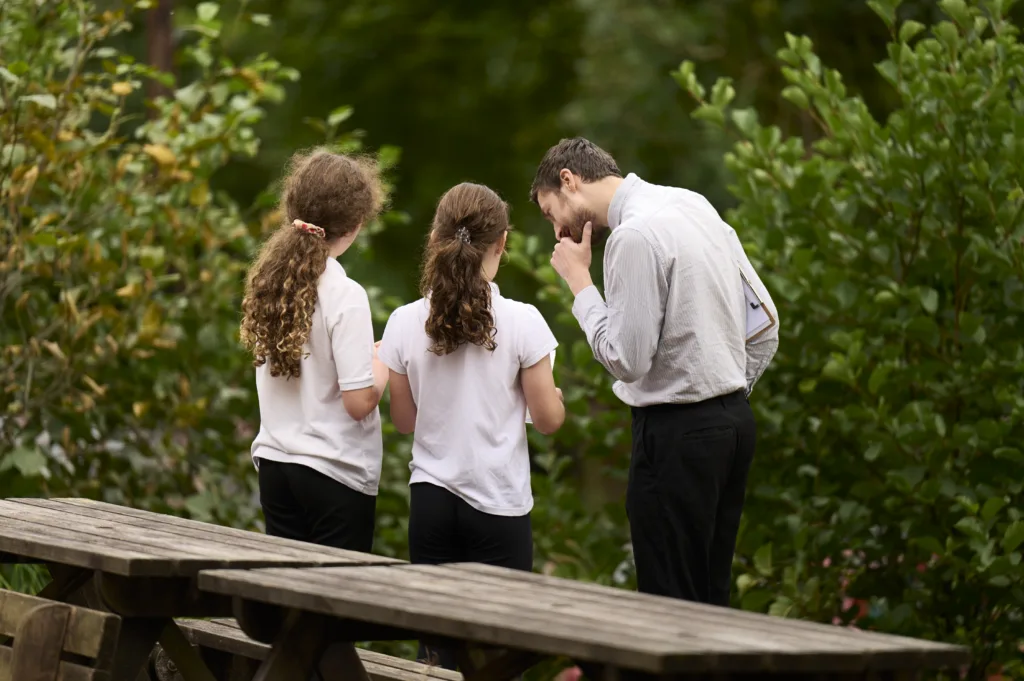
We have decided that, from now on, we are going to reduce our use of identifiable photographs of people’s faces in our communications — especially children’s.
The current state of the internet
We know that making this change won’t come without a cost. The internet was built by humans for humans. It has enabled us to connect with each other like never before, and we have benefited from that as an organisation. Learning through Landscapes exists to help real children and adults working in schools and elsewhere, and we want to appeal to them as people. Humans respond to fellow humans — we’re a social species, after all!
However, by taking this decision, we’re contributing to an online environment that feels increasingly devoid of real people. Understandably, many teachers and parents are also withdrawing from social media altogether to protect against the use of their children’s images and their own. Slowly, slowly, we’re losing the “social” in “social media”. When there are no humans left on these platforms, how will we reach the people we exist to help?
An uncertain future for digital communications
The truth is, we’re as unsure as everyone else. We’re making informed guesses at the right thing to do, but we’re following an uncharted course and we’re inevitably going to trip up along the way. We know that our policy won’t be watertight from the start. We’re going to make mistakes; it’s going to look like we’re being hypocritical at times.
For example, why are we taking action on identifiable faces in photographs, but not in video at the present time? Well, we can’t make a video about the people we’re helping without showing any people — but if we choose not to make videos at all, we won’t be able to reach people to help them in the first place! We are trying to change culture in schools, and it’s really difficult to create emotionally resonant stories without allowing real teachers and pupils to talk about their experiences to the camera.
It’s an unsatisfying answer, but it reflects the dilemma we face in the current climate. Whether we like it or not, we still have to exist in these spaces to carry out our work effectively.
Is there a silver lining?
When so much is out of our control, it’s a deeply uncomfortable time to work in digital communications. AI summaries in search results are forcing us to change our approach to our written content, and the increasing push for video on platforms like Instagram and Facebook require us to shift our communications in an audiovisual direction if we want them to be seen. Small communications teams like ours will naturally struggle to adapt to this rapidly changing environment.
Still, working in a small team comes with its upsides. It allows us to keep our mission at the heart of everything we do, taking quick and decisive action on these matters. We know that we’re not always going to make the right call, but in times of such uncertainty, it’s reassuring to know that we’re always acting with children and educators’ best interests in mind.
Of course, some things are still within our control. On social media, truth is a fickle thing. As generative AI technologies continue to be refined, it will become increasingly difficult to know whether what you are seeing is real and whether it was created with good intentions. On social media, we are only ever renting a room in someone else’s building, and it is never guaranteed.
This, however — ltl.org.uk, the very website you are browsing — is our space. We can’t control what happens to our Facebook and Instagram and LinkedIn pages, but we can control what happens here. That’s why we encourage you to come directly to the source for your information about outdoor learning and play, and creating the climate ready school grounds of the future.
In recent years, we have retreated from nature into digital spaces, at the expense of our health and the health of our planet. Learning through Landscapes exists to help more people to enjoy the outdoors, and perhaps this change to the way we use the internet will mark a positive shift in that direction. Indeed, in our ideal vision for the future, our work is no longer necessary — we’re not there yet.
If you like what we do and you want to support our work in the years to come, please sign up to our newsletter to receive updates to your email inbox, with the promise that they will always be created by humans for humans. We are people helping people, and no matter how much the digital world changes, that will remain an unchanging truth.




Related News

The social media ban for under-16s: How to redirect children from the screen to the outdoors

Using your grounds to address Emotionally Based School Avoidance