Using your grounds to address Emotionally Based School Avoidance
Across the country, more and more children are finding themselves unable to walk through the school gates. Here’s why looking to the outdoors, and the school grounds themselves, could be part of the answer.
Every teacher knows the heavy, hollow feeling of scanning the morning register and seeing that same blank space next to a child’s name. It’s a quiet daily crisis playing out in schools up and down the country. At home, it represents a complicated, exhausting morning for a family experiencing Emotionally Based School Avoidance (EBSA), where a child is physically unable to cross the school threshold due to a profoundly overwhelmed nervous system.
As an educator, you feel the professional squeeze acutely. On one side, you have a deep, genuine worry for that child’s mental health, their academic regression, and their growing social isolation. On the other side, you face relentless statutory pressure from Local Authorities, attendance frameworks, and Ofsted inspections to push your attendance metrics back up. It’s an incredibly stressful predicament where schools are often asked to solve deep-rooted societal and emotional challenges with limited time and heavily depleted budgets.

Navigating support
The immediate, logical reaction is to try and look for ways to help the child adapt and manage their distress so they can achieve compliance with the system. When school anxiety and emotional distress are correctly identified as the root causes of absence, the most obvious pathway is to look toward structured emotional support.
For children experiencing acute emotional crises, accessing targeted, evidence-based mental health interventions is hugely valuable. These services offer an irreplaceable lifeline, providing children with a safe professional space to explore their feelings and learn invaluable coping mechanisms.
Alongside these essential interventions, schools often find themselves running parallel administrative processes. When a student reaches the persistent absence threshold, standard statutory tools like automated warning letters, formal attendance reviews, and rigid attendance contracts are mechanically triggered.
The underlying, well-intentioned assumption of the wider system is that if we can just provide the right internal coping strategies or administrative framework, the student will successfully reintegrate back into the traditional classroom.
Ecological mismatch
However, whether a child has access to professional therapeutic support or not, a truly comprehensive response to school distress requires us to look beyond individual coping strategies and closely examine the underlying root causes of their anxiety. In many cases, that root cause is an ecological mismatch between the child’s nervous system and the physical school environment itself.
When we look at school avoidance through this lens, we see that a modern school building can be an incredibly intense setting for an anxious or sensitive child. Bright fluorescent lighting, echoey and chaotic corridors, dense crowds of moving people, intense social monitoring, and rigid behavioural containment present a continuous, unyielding sensory and emotional bombardment.
The human nervous system has strict metabolic and sensory limits. When an environment is chronically overwhelming, even the best cognitive coping mechanisms can be put under immense strain. When a child reaches a threshold of chronic overload, the body eventually forces a complete physical shutdown, resulting in the panic attacks, physical sickness, and total immobilisation at the school gates that characterise severe EBSA.
Crucially, this ecological mismatch doesn’t only affect the children who are absent. For every child who can’t cross the threshold, there are many others who do make it through the school gates every day, but who can barely engage with learning because they’re completely overwhelmed by their surroundings. They’re sitting in our classrooms, quietly masking their distress, while their brains are entirely consumed by the physiological effort of surviving the sensory bombardment around them.
The value of nature-rich spaces
Because the environment itself is so often the driving catalyst for this distress, addressing these physical challenges is not just an optional extra; it’s absolutely essential. Modifying the setting where learning and connection happen offers a practical, structural layer of support that changes the baseline experience for all children, providing an immediate buffer against sensory and emotional overload.
This is where your school grounds become an invaluable, untapped asset. There is a wealth of robust academic evidence demonstrating that nature-rich outdoor environments directly alter our physiological state. Pioneering research, such as the UK’s Natural Connections Project, alongside numerous environmental psychology studies, shows that moving learning and interaction into green spaces significantly drops cortisol (our stress hormone) levels, reduces hyperarousal, and restores depleted attentional capacity.
Utilising nature-rich school grounds acts as a gentle, low-sensory alternative space that accommodates the needs of an overwhelmed nervous system:
- Lowering physiological stress: Spending time in nature lowers a child’s baseline physiological anxiety, helping both school-avoidant pupils and overwhelmed classroom students feel more grounded, regulated, and emotionally ready to learn.
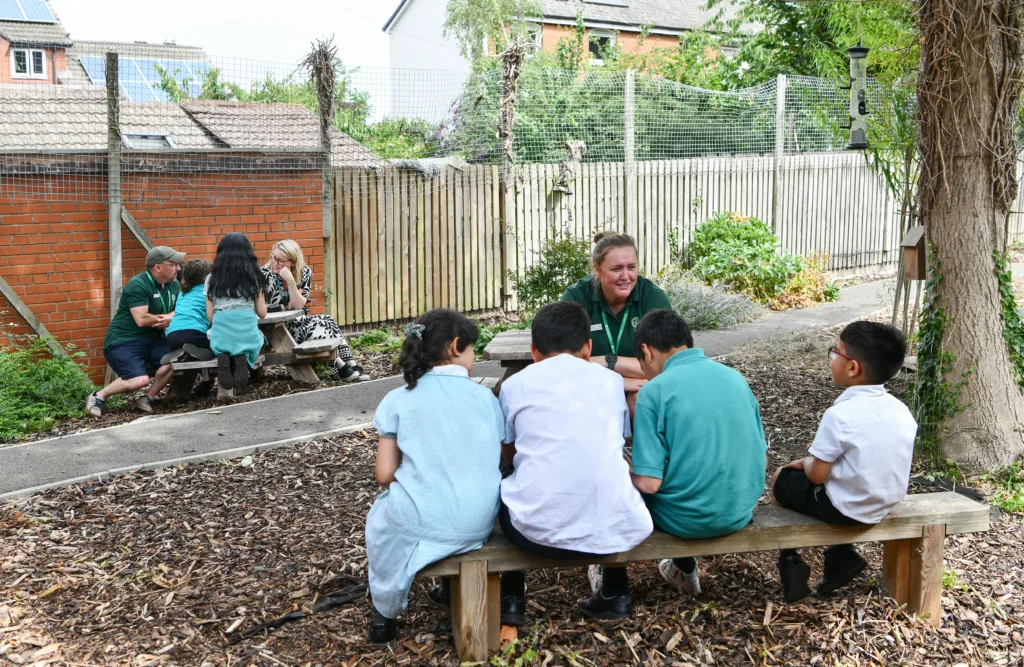
- A transitional neutral ground: The school grounds provide a low-stakes, open-air environment where a child can gradually reintegrate or take a sensory break, allowing them to reconnect with a trusted teacher or a small group of peers without the crushing pressure of an enclosed classroom.
- Building self-efficacy: Accomplishing tangible, hands-on tasks outdoors builds a genuine sense of agency and practical success, which naturally reinforces and boosts a child’s overall self-esteem and confidence.
Using the setting to support the child
Far from being an alternative to academic progress, taking the curriculum outdoors is a highly effective way to deliver core learning while simultaneously safeguarding children’s wellbeing and making school feel like a safe space. This is a practical call to look at the whole picture of school attendance and to recognise that the curriculum and the school grounds can work together seamlessly.
By intentionally utilising nature-rich school grounds, we can address the environmental triggers of school anxiety, allowing other interventions to work as effectively as possible. We stop expecting vulnerable children to carry the entire burden of adapting to a stressful environment on their own. Instead, we use the space to meet them halfway, creating a calming, healing environment where children can thrive. By lowering the sensory threshold, coming to school stops feeling like a battle for survival, reopening the school gates for the child stuck at home with EBSA, while also easing the invisible burden on those struggling to stay present.




Related News

Teaching climate change through making adaptations to school grounds


The social media ban for under-16s: How to redirect children from the screen to the outdoors